
Bernard Arnault controls one of the world’s most powerful luxury groups. Through LVMH, his business interests also extend into major media properties. Yet a search for his name demonstrates a fundamental truth of online reputation management: economic influence does not equal control of Google.
Our analysis of this U.S.-facing, English-language desktop SERP found a reputation that is broadly authoritative and commercially positive, but fragmented across Google, Wikipedia, financial media, video publishers and public search behavior. LVMH owns one prominent result; almost everything else is selected or produced by third parties.
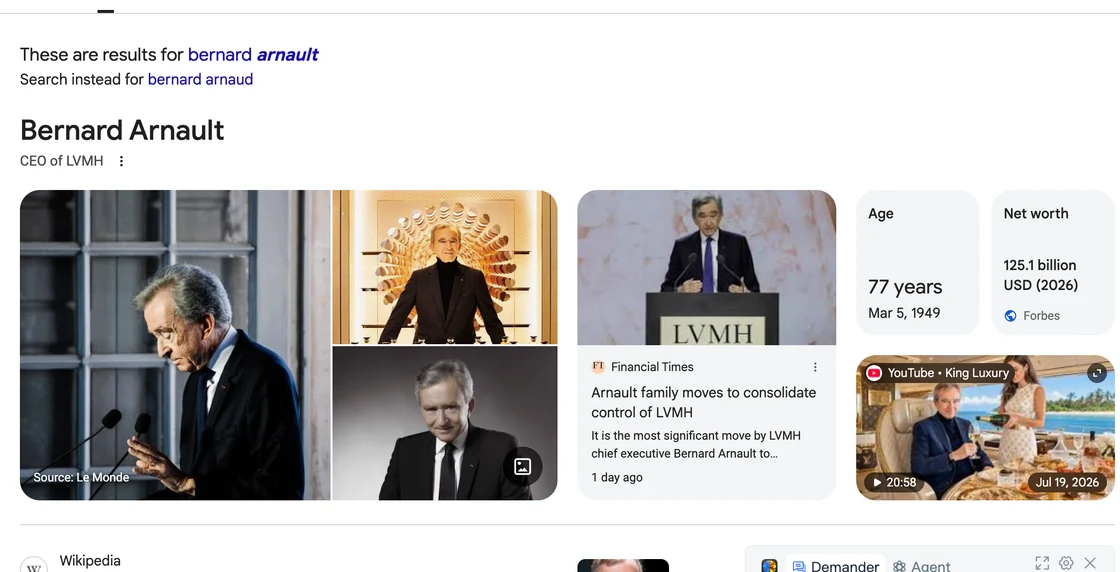
There is also a useful technical signal at the very top. The query was entered as “bernard arnaud,” but Google automatically returned results for “Bernard Arnault.” That correction shows unusually strong entity recognition. Google is confident that the misspelled query refers to the LVMH chairman, so reputational content attached to the correct entity can surface even when users spell his name incorrectly.
Methodology: The screenshots in this article were captured on , and all search-result positions described reflect what was observed on that date. This analysis uses those desktop screenshots as a point-in-time SERP snapshot. The interface is in English and was provided as a U.S. SERP, although the footer does not confirm a precise location. The ChatGPT and Ubersuggest boxes visible on the right are browser-extension overlays, not Google search features, and were excluded from the analysis.
Watch the podcast episode
Our podcast examines the same reputational paradox: Bernard Arnault can shape his official message and command substantial media influence, but he cannot determine the complete composition of his Google results.
Google defines the first impression before any click
The page opens with an entity-style module rather than a conventional blue link. Bernard Arnault is labeled “CEO of LVMH,” surrounded by formal portraits, an age card, a Forbes net-worth estimate, a Financial Times story and a YouTube video.
This is strategically important because Google is creating the first narrative before the user visits any website. The dominant themes are immediately clear: luxury, wealth, authority, family control and corporate succession. LVMH may supply some of the underlying information, but it does not control how Google combines those sources or which image receives the most visual prominence.
The images are largely formal and executive in tone. They reinforce seriousness, seniority and institutional power rather than scandal. From an online reputation perspective, that is favorable. However, the presence of a lifestyle-oriented YouTube thumbnail beside established financial journalism shows how easily editorial, corporate and entertainment content can coexist inside one identity module.
Wikipedia wins the definition; LVMH wins the official narrative
The first traditional organic result is Wikipedia. Its snippet identifies Arnault as a French businessman and chairman and CEO of LVMH. Immediately below the People Also Ask module, the official LVMH biography appears with the title “Bernard Arnault, Chairman and CEO.”
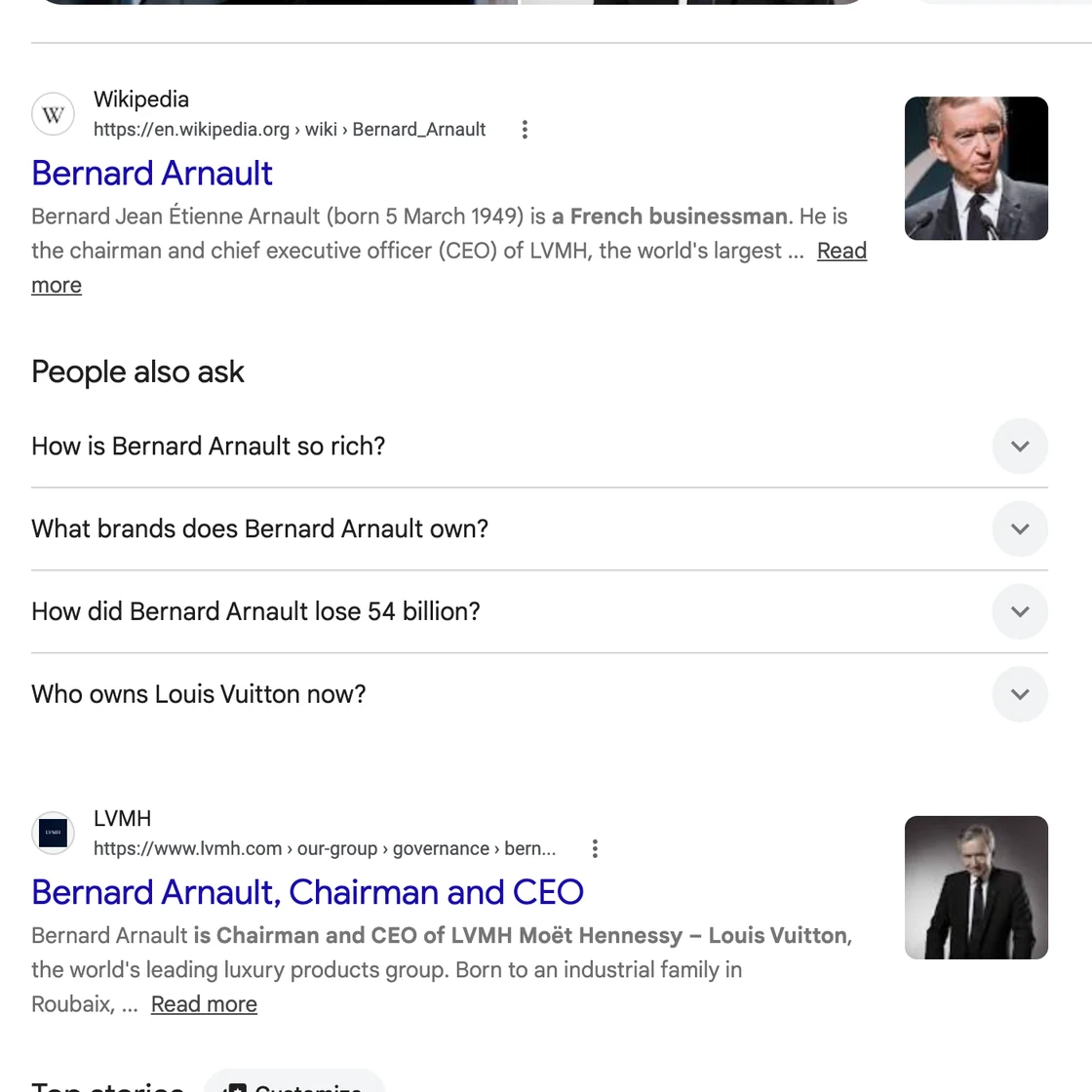
This is a comparatively strong outcome for reputation management. The official corporate biography ranks near the top and gives LVMH a direct channel for presenting Arnault’s background, leadership and institutional legitimacy. But Wikipedia still defines him first. It acts as Google’s preferred independent reference, while LVMH supplies the sanctioned version.
The People Also Ask questions reveal a different layer of reputation: audience curiosity. The visible questions focus on why Arnault is rich, which brands he owns, how he allegedly lost $54 billion and who owns Louis Vuitton. These are not questions about leadership philosophy, philanthropy or craftsmanship. They reduce the entity to money, ownership and financial volatility.
For online reputation managers, this is critical. A company can optimize its biography, but it cannot directly choose the questions Google surfaces. The best response is to publish clear, factual, well-structured answers to recurring questions and build enough authority for those answers to become eligible sources.
Current news concentrates the narrative around family control
The Top Stories block is highly consistent. The Wall Street Journal, Reuters, Bloomberg, Financial Times and WWD all cover changes to LVMH’s ownership or holding structure. The repeated vocabulary—“family,” “control,” “holding structure” and “Christian Dior”—creates a unified narrative about succession and consolidation.
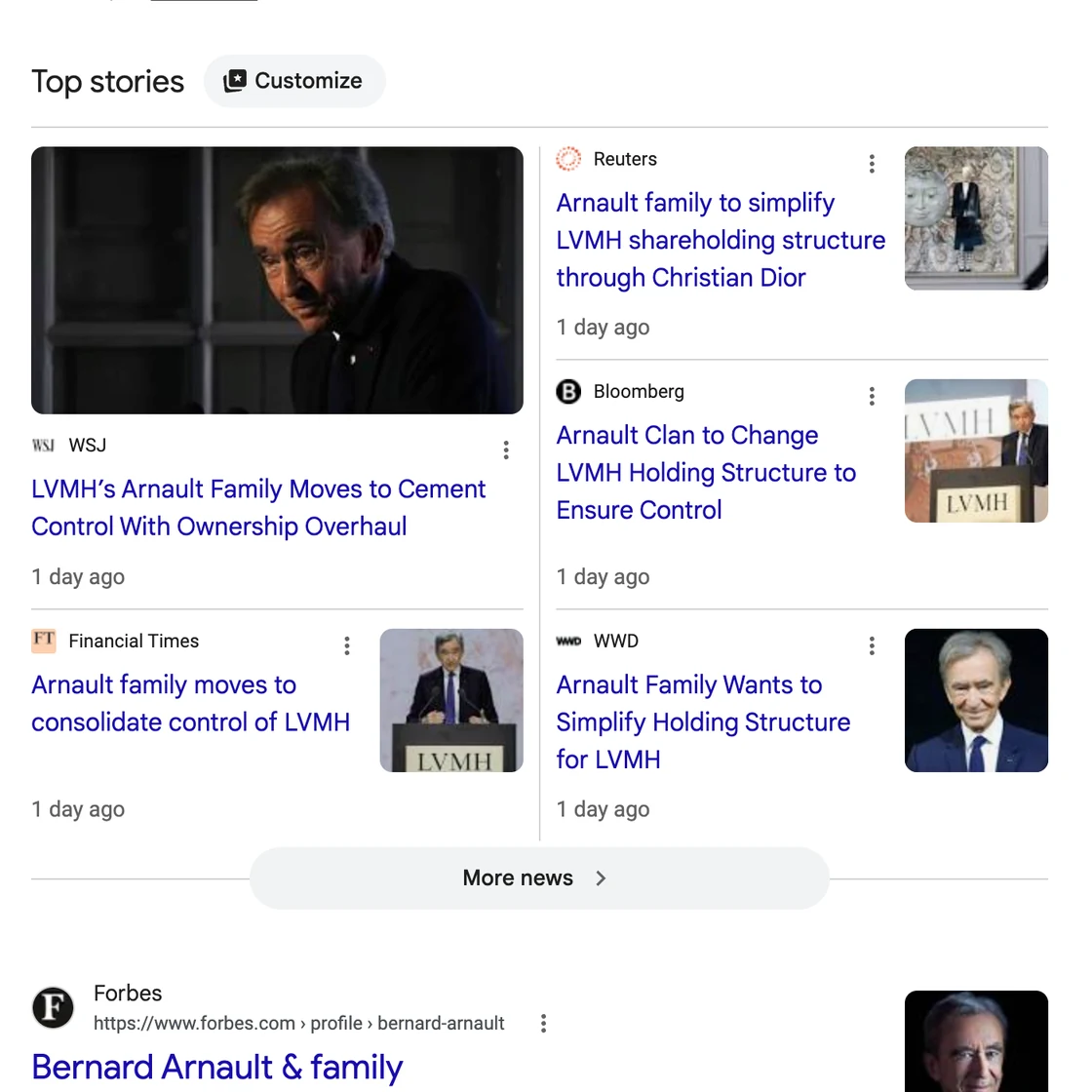
The coverage is not overtly hostile. These are reputable financial and fashion-business outlets reporting on a corporate event. Nevertheless, the cumulative effect is reputationally significant. Users are encouraged to interpret Arnault not only as a luxury executive, but as the patriarch of a family structure designed to preserve control.
This block is also the most volatile part of the page. A new investigation, lawsuit, earnings shock or succession announcement could replace the current stories within hours. Strong permanent results cannot prevent that shift. They can only provide a stable foundation beneath it.
Video is the least controlled and most sensational surface
The long-form video results include titles such as “The Trillionaire Life of Bernard Arnault” and “How Bernard Arnault Secretly Travels.” The short-video carousel goes further, using language about losing wealth, building a $320 billion luxury empire and one man dominating the world of luxury.
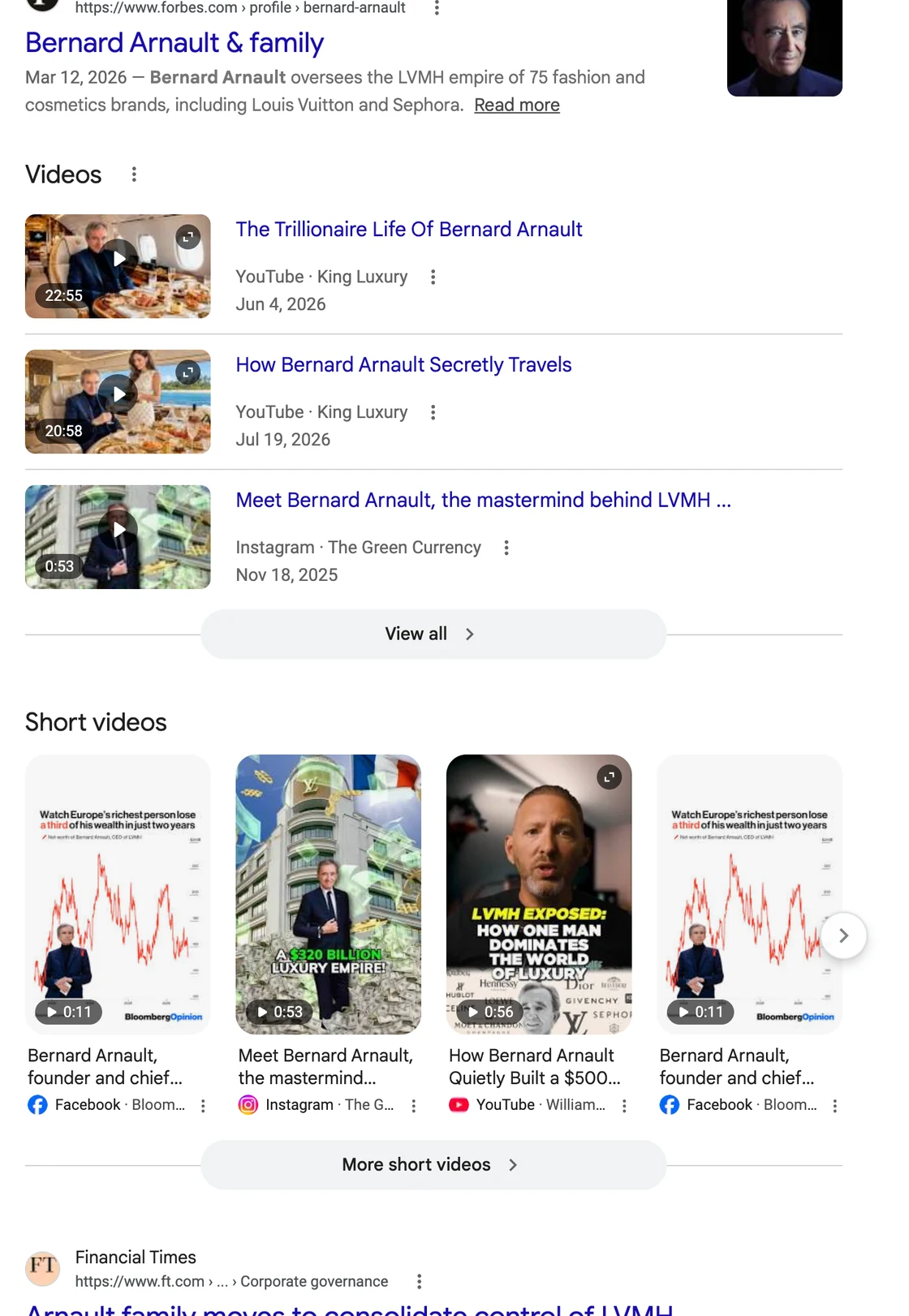
This is the weakest-controlled section of the SERP. The thumbnails and headlines are designed for attention, not institutional precision. One title calls Arnault a “trillionaire” even though the same SERP displays a much lower Forbes estimate. Another uses the word “secretly,” turning ordinary curiosity into implied mystery.
For LVMH, the opportunity is not to suppress third-party video but to compete with it. A verified, well-optimized library of interviews, executive profiles, event footage and short factual explainers could give Google stronger first-party video assets. Titles, transcripts, chapters, thumbnails and VideoObject markup would all improve discoverability. Without that content, entertainment publishers define the visual narrative.
Authority protects the lower page—but does not make it owned
Farther down, the results are dominated by established sources: Forbes, Financial Times, Britannica, Bloomberg, The Business of Fashion and Getty Images. This creates a high-authority reputation environment with relatively little low-quality web content.

The related searches reinforce those themes: book, brands, net worth, wife, son, house, children and religion. In other words, the page begins with corporate authority but ends with a mixture of commercial and personal curiosity.
Only one prominent traditional result is directly controlled by LVMH. The rest are earned rather than owned. That is not a failure; in fact, favorable third-party authority is more credible than a page filled entirely with corporate properties. The risk is dependence: Google can reorder these sources, news can change rapidly, and user-generated video can introduce sensational claims at any time.
What this SERP teaches online reputation managers
Bernard Arnault’s U.S.-facing SERP is strong, but it is not controlled. It is managed indirectly through entity clarity, an authoritative official biography and extensive coverage by trusted publications. The result is mostly positive, yet Google still decides the layout and third parties still supply most of the narrative.
An effective reputation strategy should therefore focus on five priorities:
- Protect the entity foundation. Keep biographical facts, executive titles, structured data and authoritative profiles consistent across LVMH, Wikidata and trusted databases.
- Own recurring questions. Publish concise, factual resources addressing wealth, ownership, brands, governance and succession without turning the corporate site into celebrity content.
- Build first-party video authority. Create indexable long-form interviews and short explainers that can compete with sensational YouTube and social content.
- Monitor news and multimedia separately. Traditional rankings may remain stable while Top Stories and short videos change the visible reputation overnight.
- Measure share of SERP, not only rank. Reputation is distributed across images, questions, news, videos, the knowledge panel and related searches. Ranking one official page is not enough.
The central lesson is simple: even a billionaire with global brands and substantial media interests cannot own his Google results. He can strengthen the sources Google trusts, correct factual inconsistencies and publish better assets. But the final reputation is negotiated among the individual, the organization, publishers, audiences and the algorithm. In online reputation management, influence is achievable; total control is not.