
On social media, a post is often part of an ongoing conversation. Regular followers may already know the author’s interests, opinions and tone. They may have read earlier posts and understand the background.
On Google, that familiarity cannot be assumed. Someone searches for a name and discovers a political statement, a personal photograph or a business anecdote. That post may become their first impression of its author.
The Google results for “Richard Branson,” captured on September 29, 2026, illustrate this shift. A section featuring posts from Threads and Facebook brings together an appeal to protect civilians in conflict zones, personal memories and a story about Virgin.
A message can mean something different to a new reader even when the wording stays exactly the same.
Your Post May Be Someone’s First Impression of You
Three cards in the recent posts section show different sides of Richard Branson.
The first calls for the protection of civilians in Sudan, Ukraine and Gaza. The second shares personal moments and memories. The third recalls a product concept Virgin imagined in the 1980s.
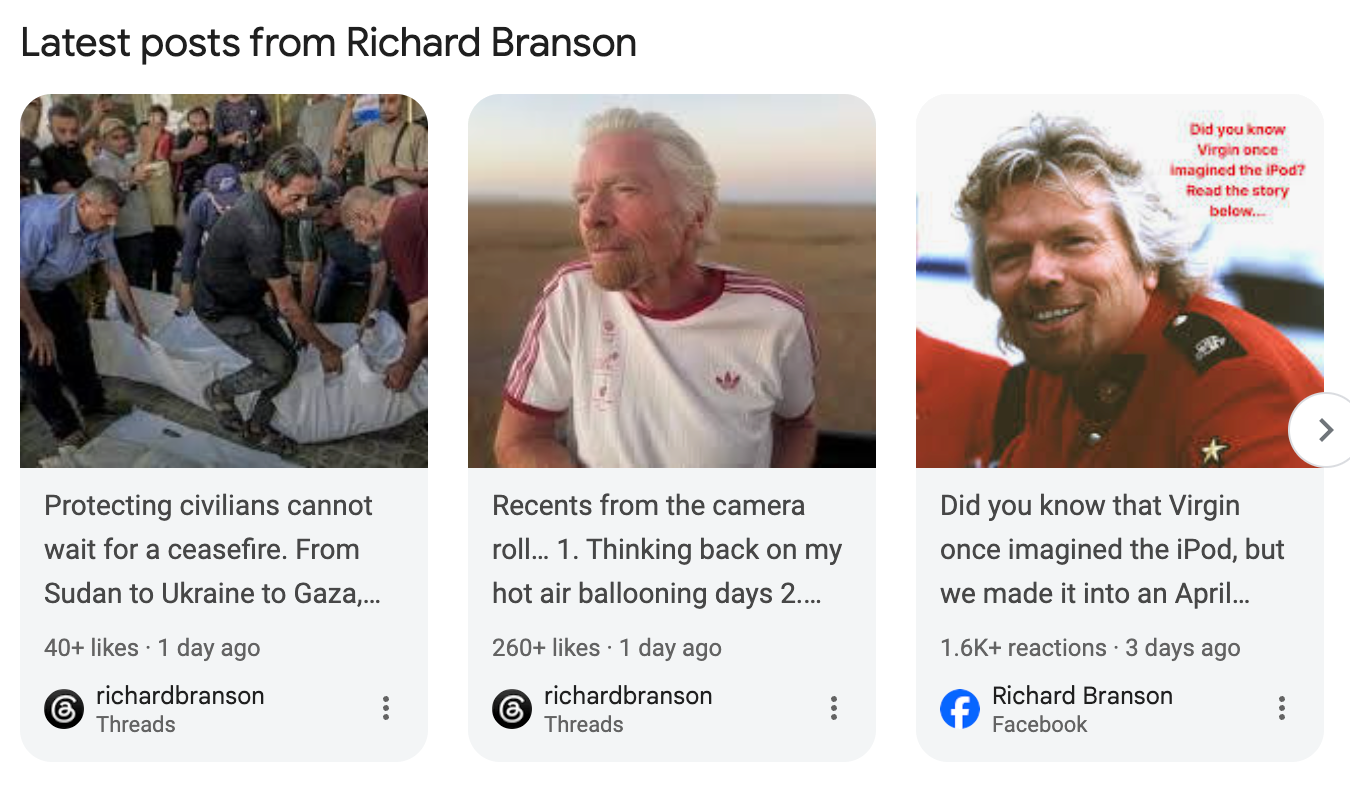
For a regular follower, these posts may feel consistent with the person they already know. For someone looking him up for the first time, they help establish who he is.
A follower may be asking, “What is he sharing today?” A visitor arriving through Google may have a more basic question: “Who is this person?”
The same post can end up answering both.
The screenshot cannot tell us what readers think or remember. It does show how social media posts can introduce an executive to people who have never visited their profiles.
The Excerpt May Be All the Reader Sees
Each card displays an image, the opening lines, the platform and details such as when the post appeared and how people responded. To read more, the visitor must click through.
That makes the opening lines particularly important. An explanation later in the post or a qualification in the final sentence may never be seen.
The card about civilians shows the opening appeal before the text cuts off. The Virgin card begins an anecdote without displaying the full story.
These excerpts may therefore be read as messages in their own right.
For executives, this is worth considering before publication. An ironic remark, a provocative opening or a response to a specific event can become harder to interpret when separated from the rest of the post.
Would the opening lines still make sense if the reader saw nothing else? That is a useful check before posting about a sensitive subject.
Should Every Post Be Written for Google?
Posts should still sound natural. But public content can travel beyond its intended audience through search results, articles or screenshots.
The care taken should reflect the subject. A vacation photograph calls for less preparation than a statement about a conflict or a business decision. The more sensitive the topic, the more important it is that the message makes sense without prior knowledge.
Watch the episode
Richard Branson’s Website Is Losing to LinkedIn—Here’s Why
Continue exploring Richard Branson’s search presence with this related episode. You can watch it here or discover the episode on YouTube.
Two Checks Before Posting About a Sensitive Subject
Is the Subject Clear From the Start?
“This is unacceptable” may work in a conversation where everyone knows what is being discussed. Read in isolation, it leaves people to fill in the missing context.
Naming the event, decision or issue makes the message easier to understand. It also helps future readers, after the news cycle has moved on.
Branson’s post about civilians names several conflicts in its opening lines. Even in the shortened version, readers can identify what he is addressing.
Does the Message Still Hold Without the Final Sentence?
A qualification that materially changes your meaning should not appear only at the end of a post.
State your position clearly, then develop it. Keep any essential limits or qualifications close to the statement they apply to.
Otherwise, someone who reads only the opening may come away with a different understanding from someone who reads the full post.
Check How Your Posts Appear Beyond the Platform
A message that makes sense on its original platform may feel incomplete elsewhere.
Reputation monitoring should therefore include the excerpts displayed in search results. Which lines are visible? What image accompanies them? Are the source and date clear? Does the link take readers to the full post?
In the Branson screenshot, the platforms are clearly identified and the cards indicate how recently the posts were published. These details provide useful context, even where the text is cut short.
If an excerpt raises concerns, first establish what the problem is. A shortened post is not automatically misleading. And disagreement with an opinion does not necessarily mean the opinion has been misunderstood.
The response should match the issue: correct an error, clarify ambiguous wording or leave an accurately presented message alone. Appearing on Google is not, in itself, a reason to intervene.
Can Someone Who Doesn’t Know You Understand Your Message?
The search results for “Richard Branson” show how social posts can become part of an executive’s introduction to the public. Someone looking up a business leader also encounters his personal memories, public commitments and business stories.
That can give readers a fuller sense of the person behind the title. It also means some readers will encounter a post without knowing the author’s usual tone or previous statements.
Before publishing an important message, ask: could someone unfamiliar with you understand your position from the excerpt alone?
At Online Reputation Management 24, this question is part of an assessment that goes beyond Google rankings. We examine how your messages appear in search results, what context remains visible and whether the excerpts accurately convey what you intended to say.
Frequently Asked Questions
Can my social media posts appear in Google even if someone doesn’t follow me?
Yes. Public posts may appear in search results for your name or a relevant topic. Someone can therefore encounter your content without following you or visiting your profile.
Does Google display the full text of a social media post?
Not always. Search results may show only an image and a short excerpt. Readers might see your opening statement without the explanation or qualifications that follow.
Should executives avoid sharing personal opinions on social media?
Personal opinions can help people understand an executive’s values and personality. The important consideration is whether the message remains clear to someone unfamiliar with the author or the context.
Should I delete a post if its Google excerpt could be misunderstood?
Not automatically. First compare the excerpt with the full post and identify the ambiguity. Clarifying the wording may be enough. Deleting the original also does not guarantee that it will immediately disappear from search results or remove copies shared elsewhere.
How can I check what Google shows from my social profiles?
Search for your name and review the social results, including the text, images, dates and source labels. Repeat the check periodically, as results can change. If your audience spans several markets, compare relevant languages and locations.
Does a social post appearing on Google mean it is damaging my reputation?
No. Visibility alone does not indicate harm. A post may strengthen your public profile, provide useful context or have little effect. Assess its accuracy and relevance before deciding whether any action is needed.